Car owners have been using different paint-protection treatments for decades. Wax was once the standard choice, followed by products such as Teflon coatings and, more recently, ceramic coatings. Each treatment promises a cleaner-looking, glossier vehicle, but the technology and level of protection can be quite different.
So, what is Teflon coating, and why are many car owners now considering ceramic coating instead?
The answer becomes clearer when you look at how each treatment works, what it can realistically protect against, and how long the results are expected to last.
What Is Teflon Coating?
Teflon is a brand name associated with polytetrafluoroethylene, or PTFE. In automotive detailing, the term “Teflon coating” has traditionally been used for a paint treatment designed to leave a smooth, slick layer over the vehicle’s exterior.
The main attraction is the finish. A properly prepared car can look noticeably shinier and feel smoother after treatment. The surface can also become more resistant to certain contaminants, making routine washing somewhat easier.
But there are differences when it comes to auto Teflon coatings. There are variations in the formula, process used for preparing it, and the way it is applied. That is why car owners need to find out which particular Teflon coating is being used on their car.
What Protection Does Teflon Provide?
Teflon coating is primarily a surface treatment rather than a thick protective barrier.
Its slick finish can help reduce the tendency of dirt and contaminants to stick firmly to the paint. It may also provide some resistance against environmental exposure.
But it shouldn’t be treated as protection against stone chips or serious scratches. A thin coating cannot absorb the impact of a sharp piece of gravel in the same way that a physical paint protection film can.
This distinction is important because marketing terms can sometimes create unrealistic expectations.
Enter 9H Ceramic Coating
A 9H ceramic coating takes a different approach.
Modern ceramic coatings are generally based on silicon-containing compounds that form a durable layer over properly prepared automotive paint. Once cured, the coating creates a hard surface with strong water-repellent properties.
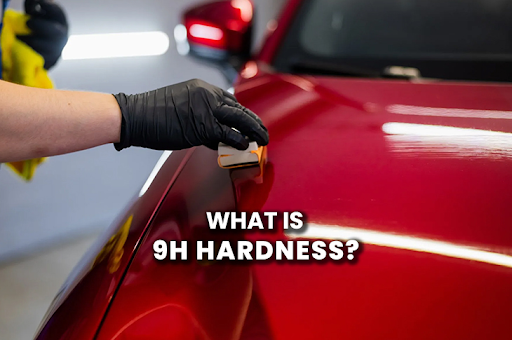
The “9H” terminology is associated with pencil-hardness testing. It does not mean that the vehicle becomes completely scratch-proof.
One of the most noticeable benefits is hydrophobicity. Water tends to bead and move away from the surface, while loose dirt may be easier to wash off.
How Does Ceramic Coating Improve on Teflon?
The biggest difference is durability and surface behaviour.
Traditional Teflon treatments are generally intended to provide short- to medium-term enhancement of gloss, smoothness, and basic surface protection. Ceramic coatings are engineered as longer-lasting protective layers.
A quality 9H ceramic coating can offer better resistance to environmental contaminants and more pronounced water repellency. When properly maintained, it can remain effective considerably longer than a conventional surface treatment.
Ceramic coating can also enhance the depth and clarity of the paint, particularly when paint correction is carried out before application.
That preparation is crucial. Applying an expensive coating over neglected paint won’t suddenly make the underlying scratches disappear.
What About Scratches?
This is where expectations need to remain realistic.
Neither Teflon nor ceramic coating makes a vehicle immune to scratches. Ceramic coatings are harder than many traditional protective treatments, but they are still extremely thin compared with PPF.
A branch, sharp object, or stone can still damage the paint.
The main advantage of ceramic coating is improved surface resistance and easier maintenance, not bulletproof protection.
For owners primarily worried about stone chips, PPF remains a more suitable option because it acts as a physical sacrificial layer.
Which Treatment Is Better for an Older Car?
It depends on the condition of the paint.
If the vehicle needs a basic gloss enhancement and the owner wants a relatively simple treatment, Teflon may still be suitable.
If the owner wants longer-lasting hydrophobic behaviour and is prepared to invest in proper preparation, a 9H ceramic coating can make more sense.
For heavily oxidised or scratched paint, correction should be discussed before either treatment is applied.
Maintenance Still Matters
A coating isn’t a substitute for regular car care.
Harsh chemicals, abrasive washing tools and poor cleaning practices can affect the appearance of any surface treatment. Using appropriate car shampoo and washing methods helps maintain the finish.
Owners should also follow the specific aftercare instructions supplied by the coating manufacturer or installer.
Regular maintenance is especially important when paying for a premium treatment. The better the surface is cared for, the easier it is to preserve its appearance.
Conclusion
Understanding what Teflon coating is helps put the treatment into perspective. It is mainly a surface-finishing solution that can improve smoothness, gloss, and resistance to everyday contaminants.
A 9H ceramic coating builds on the idea of surface protection by providing a harder, more durable layer with stronger hydrophobic properties and generally longer-lasting performance.
Neither product can prevent every type of damage, and neither replaces PPF when impact protection is the priority. The right choice depends on the car’s condition, driving environment, budget and expectations.
For owners looking beyond short-term shine and wanting easier maintenance with longer-lasting surface protection, ceramic coating offers a more modern approach to caring for automotive paint.