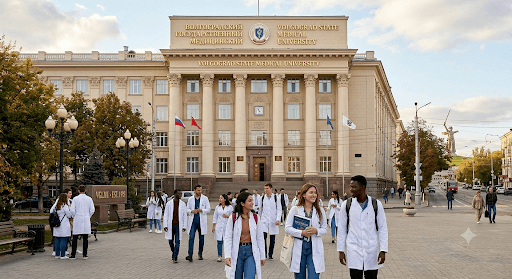
India sends tens of thousands of students abroad every year to pursue medical education. MBBS in Russia remains one of the most popular destinations in this category, with dozens of government universities offering recognisedprogrammes at affordable costs. Among them, Volgograd State Medical University in southwestern Russia has built a significant following among Indian students over the past two decades. This article covers the university’s background, fees, clinical infrastructure, and — critically — the security situation in Volgograd that every student and family must assess honestly before applying.
History and Background
The university was established in 1935, originally as the Stalingrad Medical Institute, named after the city’s former name. Volgograd is famously known as the site of the Battle of Stalingrad during World War II — one of the most significant battles in modern history. The university grew steadily through the Soviet period and began accepting international students in 1962. English-medium instruction for MBBS students was introduced in 2000, which opened enrolment significantly. Today, the university has trained over 2,500 international graduates across 70 countries.
Recognition Status
The university is recognised by the National Medical Commission (NMC) of India, the World Health Organization (WHO), and is listed in the World Directory of Medical Schools (WDOMS) since 1995. It also holds recognition from FAIMER and ECFMG. This recognition profile covers the baseline approvals required for Indian graduates to remain eligible for India’s licensing exam after completing the programme. Students should confirm the current NMC status directly at the time of application, as these lists are periodically reviewed.
Course Structure
The MBBS-equivalent programme runs for six years — five years of academic and clinical coursework, followed by one year of internship. Instruction is conducted entirely in English throughout the programme. Russian language training is provided alongside, primarily for clinical communication during hospital rotations. The curriculum is governed by Russia’s Ministry of Health and meets NMC’s stipulation of 54 months of academic training followed by a 12-month internship.
Clinical Exposure
This is one of the stronger points of the university. It operates through 15 affiliated clinical hospitals and polyclinics. Each year, clinical departments conduct over 1,30,000 outpatient consultations and perform more than 12,000 surgical procedures. Research activity is also active — 90 to 110 new research methods and 120 to 150 new treatment methods are introduced annually. The library holds approximately 7,00,000 volumes of academic and scientific literature. The university employs over 780 faculty members, with a large proportion holding doctoral qualifications.
Fees: What the Research Shows
Multiple sources place the current annual tuition fee at approximately RUB 4,65,000 per year. In USD terms, this translates to roughly USD 5,000 to 5,500 per year depending on the exchange rate at the time of payment. The university has seven hostels available for international students, with hostel fees reported separately. One consolidated estimate puts the total six-year cost including tuition, hostel, and living expenses at approximately Rs. 24 to 32 lakh, though this range depends significantly on currency rates and individual lifestyle.
As with all fee figures sourced from third-party websites, students should request an official, current, itemised fee structure from the university. Fees change annually, and the INR equivalent fluctuates with the Ruble exchange rate. Always calculate on the basis of a complete six-year estimate — not tuition alone.
Hostel and Student Life
Seven hostels are available for international students on and near campus. Indian food is available in the mess facility, with vegetarian and non-vegetarian options. There is an established Indian student community of approximately 900 students, which is one of the larger concentrations of Indian students at any single Russian medical university. Indian festivals including Diwali and Holi are celebrated on campus. Volgograd is a large city with a population of over one million, offering a range of urban amenities, public transport, and market access.
The Security Situation: This Section Requires Careful Reading
Volgograd is located in southwestern Russia, approximately 700 kilometres from the Ukrainian border. The city has significant defense industry infrastructure, which has made it a recurring target in Ukraine’s long-range strike campaign against Russian military and industrial facilities.
The following incidents are documented from verified international news sources in 2025–2026:
In late June 2025, Ukrainian forces struck the Marinovka Air Base in Volgograd Oblast, damaging multiple Su-34 aircraft. In 2025, drone strikes hit railway infrastructure in Volgograd Oblast on multiple occasions, causing bridge restrictions and power substation fires. In April 2026, oil pumping stations in Volgograd Oblast were struck as part of a wider campaign against Russian energy infrastructure. In late June 2026, Ukrainian Flamingo missiles struck the Titan-Barrikady plant in Volgograd — a facility producing artillery systems and components for missile launch systems. The attack was confirmed by Ukrainian President Zelenskyy and by the Volgograd regional governor, who reported that 10 people were wounded and production facilities were damaged.
These are strikes on industrial and military targets, not on university campuses. However, the pattern of recurring strikes on Volgograd’s defense and energy infrastructure across 2025 and 2026 is a material fact for any family evaluating whether to spend six years in this city. The Indian Embassy in Moscow periodically issues safety advisories for students studying in Russia. Families should check the current advisory and assess the risk profile honestly, not on the basis of assurances from admission sources.
FMGE: The Standard Caution
After completing MBBS in Russia, Indian graduates must clear the FMGE or NExT exam to obtain a medical licence in India. University-specific FMGE pass rate data should always be sourced from official National Board of Examinations reports rather than from consultancy or admission websites. The national FMGE pass rate was 29.62% in December 2024 and 20.89% in June 2024. Individual university outcomes can vary significantly within this national range.
Final Word
Volgograd State Medical University has a long history, a large Indian student community, strong clinical affiliations, and full NMC recognition. These are genuine positives. The security situation in Volgograd is, however, a real and current factor — not a theoretical concern — and families should weigh it honestly alongside fees and academic reputation when making a decision of this magnitude. Always verify current NMC status, get an all-inclusive six-year fee breakdown, and check the Indian Embassy’s latest advisory before finalising any application.
For More Info Visit:- leadersmagazine.org


