A high intensity home workout no equipment approach uses bodyweight exercises performed at high effort levels to produce cardiovascular and muscular adaptations without gym access or equipment. This article covers what the science shows about HIIT workouts without equipment, how sessions can be structured at home, and what physiological factors influence their effectiveness.
What Is HIIT and How Does It Function Physiologically?
High-Intensity Interval Training (HIIT) involves alternating periods of near-maximal physical effort with shorter recovery intervals. During high-intensity phases, the body draws on anaerobic energy systems. Recovery periods allow partial restoration before the next work interval begins. This cycle creates an oxygen debt — formally termed Excess Post-Exercise Oxygen Consumption (EPOC) — which elevates caloric expenditure beyond the training session itself.
Research published in peer-reviewed exercise science journals indicates that HIIT workouts without equipment performed for 20 to 30 minutes can produce cardiovascular and metabolic adaptations comparable to longer moderate-intensity sessions. This has made HIIT a studied option for environments where equipment or extended training time is unavailable.
Physiological Effects of Bodyweight High Intensity Training
Bodyweight intense exercise at home produces several documented physiological responses when training volume and intensity are sufficient:
Muscular Adaptation Through Bodyweight Exercise
- Stabiliser muscles activate at higher rates during bodyweight training because no machine constrains the movement path, requiring greater neuromuscular coordination.
- Compound bodyweight movements such as squats, push-ups, and lunges recruit multiple muscle groups simultaneously, producing broad musculoskeletal stimulus.
- Controlled eccentric loading during bodyweight exercises contributes to muscular adaptation, particularly when movement tempo is deliberate.
- Connective tissue — including tendons and ligaments — adapts progressively to load through bodyweight training, consistent with responses seen in free-weight exercise.
Sample HIIT Workouts Without Equipment by Fitness Level
The following are two structured home HIIT workout formats organised by training experience:
Beginner HIIT Home Workout (20 Minutes)
Work interval: 30 seconds. Rest interval: 30 seconds. Complete 4 rounds.
- Jumping jacks
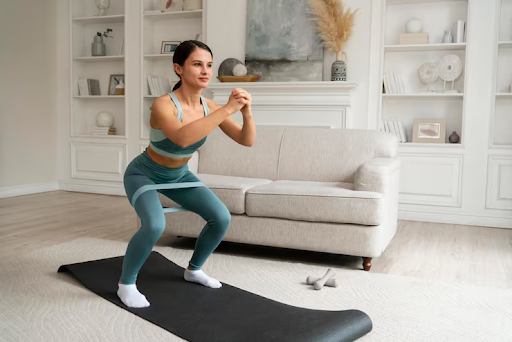
- Bodyweight squats
- Modified push-ups (knees on floor)
- High knees (low-impact variation: marching in place)
- Glute bridges
Intermediate No-Equipment HIIT Circuit (30 Minutes)
Work interval: 40 seconds. Rest interval: 20 seconds. Complete 5 rounds.
- Burpees
- Jump squats
- Pike push-ups
- Mountain climbers
- Tuck jumps
- Plank-to-downward dog transitions
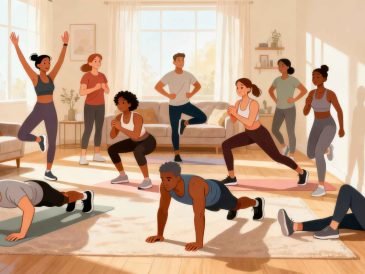
For a home hiit workout men can adapt by incorporating single-leg squat variations and explosive push-up progressions to increase mechanical demand in the absence of external load.
How to Structure Intense Exercise at Home
A structured intense exercise at home session follows a standard periodisation format:
- Warm-up (5 minutes): Dynamic movement preparation — hip rotations, leg swings, arm circles, and low-intensity aerobic activity
- Main HIIT block (20-25 minutes): Alternating between upper-body, lower-body, and total-body movements to distribute muscular load
- Cool-down (5 minutes): Static stretching targeting worked muscle groups, combined with controlled diaphragmatic breathing
A training frequency of three to five sessions per week, with at least one full rest day between sessions, is consistent with standard recovery guidelines for HIIT programming.
Common Errors in Home HIIT Sessions
Omitting the warm-up: Beginning high-intensity work without preparing the musculoskeletal system increases injury risk, particularly at the knee and hip joints.
Compromising technique under fatigue: When movement quality deteriorates, the exercise should be stopped or modified. Poor technique reduces training stimulus and increases joint stress.
Repeating the same session pattern: The body adapts to repeated stimuli over time. Rotating exercise selection on a weekly basis maintains progressive demand on the neuromuscular system.
Insufficient post-workout protein: Muscle protein synthesis following resistance exercise is supported by protein consumption within 30 to 60 minutes of session completion.
Conclusion
A structured high intensity home workout no equipment programme can produce cardiovascular and muscular adaptations supported by exercise science research. The primary variables that determine outcomes are effort intensity, session structure, training frequency, nutritional intake, and recovery quality. HIIT workouts without equipment represent one training modality among several; their suitability depends on individual health status, baseline fitness level, and training objectives.