We were racing the clock to achieve stable production for an automotive-grade finishing product. Technically, we were ready for the new product the reactors were installed and the mixing tanks calibrated. But we hit a big snag with our chemical raw materials when our regular supplier experienced a supply chain problem and our procurement team had to find a second source of the solvent from a totally unverified distributor.
At the surface, everything seemed fine with the documents. However, once that solvent was put into our process things went totally wrong. The formulation did not stabilize, the viscosity was very much off and the whole 10-ton batch was a waste. Traces of heavy ends and moisture contamination that distributor without proper quality control were the reasons why those traces were not caught. Work had to be stopped for four days, the system was cleaned and the company had to bear a huge financial loss.
This mishap showed me what is perhaps the most important lesson that, in the industrial sector, your finished product is only as good as your supply of chemicals. Operating in rapidly industrializing markets such as India, where infrastructure, automobile production, and flexible packaging are among the fastest growing industries, even a single weak link in your supply chain of raw materials can completely disrupt your business.
And at the heart of the chemicals driving these high-growth sectors is a key component: Normal Butyl Alcohol. In fact, wherever your usage of Normal Butyl Alcohol is either direct as solvent or indirect as starter material for butyl acetate and acrylate derivatives, the stability of your operations will be dictated by the trustworthiness of your chosen supplier. Let us first explore the changed industrial scenario that has led to revived normal butyl alcohol suppliers. Next, we look forward to classifying an ideal, reliable partner who is capable of sustaining uninterrupted production.
The Industrial Surge and Changing Market Dynamics
The chemical industry in India and other emerging markets worldwide is experiencing a huge transformation. Instead of fragmented, purely transaction-based buying, the supply chains are evolving into highly integrated, resilient structures. The shift is even more visible if you look at the role of Chemical Raw Material Suppliers in enabling manufacturing sectors which are the focus of the government’s “Make in India” program.
Drivers of the Chemical Boom
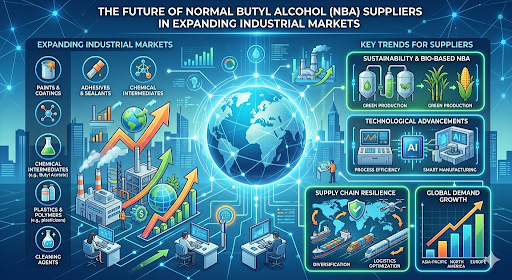
Some important macro-economic factors behind soaring demand for intermediates of industrial chemicals are:
- Infrastructure & Smart Cities: The move towards building smart cities, with renewed associated infrastructure development, has created an unparalleled demand for performance architectural coatings and protective paints.
- Automotive Resurgence: Automotive coatings require not only excellent distribution but also high gloss properties, the quality of solvents directly influences these.
- The Flexible Packaging Boom: The surge in e-commerce and changing habits of consumers have led to increased requirements of printing inks and flexible packaging solutions where drying on the spot and solvent clean evaporation properties are essential.
Indeed, such situations make us realize that a company’s growth is not only about expanding manufacturing units but also perfectly securing the material supply. Markedly, a rising demand for normal butyl alcohol suppliers who can go large, expedite supplies, and strictly adhere to quality levels is far outstripping current supply in Indian manufacturing.
Technical Non-Negotiables: Looking Beyond the Data Sheet
The first mistake many procurement teams make when considering normal butyl alcohol suppliers in India and globally is treating the chemical as just another simple commodity. A spec sheet is checked, a “99.5% purity” is seen, and all options are assumed equal.
A certificate of analysis (CoA) is just a picture of the moment. What is really needed to guard your production line is to dig deeper and understand what parameters of chemistry truly make the difference between a high-quality product and an inferior batch.
- Purity Profile Including Isomeric Impurities
A molecule called Normal Butyl Alcohol carries the structure CH₃(CH₂)₃OH. From propylene, the oxo process delivers n-butyraldehyde alongside isobutyraldehyde in one go. If separation during distillation isn’t sharp enough, tiny bits of isobutyl alcohol can sneak into what should be only normal butyl alcohol.
That tiny shift in measurement? It alters how fast the coating dries, also changing how deeply it dissolves. Mistakes like hazy film or bumpy texture often trace back to these quiet imbalances – common in premium lacquer work, especially when heat speeds the cure.
2. Moisture and Acidity: The Silent Factors That Induce Failure
Moisture content is an additional very important point. A premium product should carry a water content much lower 0.05% by weight. If the supplier does not give enough importance to storage standards, the atmospheric moisture would keep leaking into the product.
Acrylate or acetate synthesis reactor is a stage where excess moisture acts as a competitor or inhibitor to the reaction and thus the yields of the conversion would decrease significantly and you’d need to use more energy to get rid of the water. Besides that, higher moisture levels combined with high acidity (> 0.005% acetic acid) would result in faster corrosion of your stainless steel storage tanks and the pipelines used for the processes.
The Strategic Blueprint to Spot the Best Normal Butyl Alcohol Suppliers
Since the technical boundaries have been set, let us now discuss about the strategy! What is the way to identify the best Normal Butyl Alcohol suppliers in the business who are deserving of the partnership beyond marketing spiel and complexity?
To start with, many companies may just concentrate on the price per kilogram, thereby ignoring the larger risk picture. The best way to construct a resilient supply chain is to carry out a supplier audit along three dimensions.
Step 1: Evaluate Manufacturing and Infrastructure Prowess
You will want to work with a supplier who attaches a high premium to the scientific and exact measurement aspects of chemical distribution rather than just looking at it as the movement of goods from one point to another.
- Sourcing and Direct Integration: Get to know where your potential chemical distributor obtains their raw material from. Are they sourcing directly from the major global petroleum chemical companies of tier-one level, or are they simply buying the most undesirable, leftover, end-of-run stock from secondary brokers? The nearer your chemical distributor is to the primary oxo-alcohol manufacturing plant, the more stable your chemical purity will be.
- Dedicated Infrastructure: Contamination from one chemical to another is a major problem in chemical distribution. A single tanker truck that carried a crude plasticizer yesterday could spoil an alcohol consignment today if it isn’t properly washed. So ask your potential partners whether they use dedicated bulk storage terminals as well as dedicated ISO tanks or road tankers for their solvent lines.
- In-House Quality Control (QC): An upstanding supplier does not only give you the manufacturer’s CoA but they themselves independently conduct gas chromatography (GC) and Karl Fischer titration tests on every batch before it leaves their depot.
Step 2 : Audit Logistics Scale Financial Health
Idle machines cost more than expensive materials ever could. What matters most? Not the quote on paper, but whether trucks arrive when promised. Pick a vendor for acetone-like consistency under pressure, not just the number at checkout. Their logistics backbone becomes yours, whether storms hit or ports jam. Speed wins only if it never breaks.
- When things go sideways overseas – like a refinery halting output or ships backing up at ports – it hits supply chains fast. A reliable ally keeps large volumes of materials stored locally, either in coastal tanks or landlocked warehouses across India. That kind of backup means production doesn’t stall when outside shocks hit. Think delayed shipments, raw material scarcity, or unexpected plant shutdowns. Having stock on hand acts like a shock absorber. It bridges gaps until normal flow returns. Not every supplier plans ahead like this. Those who do help maintain steady movement despite chaos elsewhere.
- Surprise deliveries might test your supplier. What happens when output needs double overnight. Can goods move out fast – say, under two days – or does red tape slow everything down. Dispatch delays often hide behind policy excuses. A week stuck waiting reveals more than promises ever did.
- Because prices of Normal Butyl Alcohol track closely with propylene and crude oil, swings in those markets can quickly erase profit. When volatility hits, big suppliers rely on careful stock control along with financial tools to manage risk. Instead of fixed rates, they often offer pricing tied to formulas. This approach helps shield buyers when conditions turn unpredictable. Stability comes not from promises but from structured responses to shifting inputs.
Step 3: Check Rules and Environment Fit
Nowadays, rules for handling chemicals – both in India and around the world – are more strict. If your supplier breaks one of those rules, authorities might shut them down without warning. That could cut off your supply of raw materials right away.
- BIS and International Standards: Make sure the product is in full compliance with all relevant national and international quality standards. In India, keeping track of continually evolving Bureau of Indian Standards (BIS) certifications for chemical inputs is absolutely necessary.
- Safety Data Sheets (SDS) and Handling Training: Enjoy a professional partner who can provide you with comprehensive, updated GHS-compliant Safety Data Sheets, and they may even provide handling and safety training for your warehousing and operation staff.
The Cost vs. Value Paradox: Navigating the Pricing Maze
Here’s something no one likes to mention: cost. If you’re stepping into India’s crowded B2B space, cutting expenses feels almost irresistible – especially on materials. Chances are high you’ll hear from informal suppliers quoting rates 5% to 10% under standard figures, though what they deliver might miss common quality bars.
However, I think we’d better look at the hidden equation. Let’s unpack how much it will truly cost you economically if you opt for a dodgy distributor instead of reliable normal butyl alcohol suppliers in India.
Structuring Long-Term Success: Building a Supply Partnership
At the end of the day, whether it’s a wire-and-cable setup, an automotive assembly line, or a chemical processing plant, they all depend on the same basic principle: consistency. You cannot build a world-class manufacturing business on erratic, transactional sourcing.
When exploring growth in heavy industries, step away from seeing chemical buying as separate transactions. Think ahead. Connect with suppliers who think beyond the next deal. Ask where materials really come from. Check how they store what they sell. Expect clear answers. Insist on strong performance when it comes to quality and safety.
Start by choosing someone ready to match your forecast plans, set fixed prices for clear time frames, yet provide solid shipping help. True, it may seem much to ask, still the stability, standard, and success of what you build depend heavily on the materials picked now. Skip distractions, put proven consistency first, then go with a source that grows alongside you without slowing down.