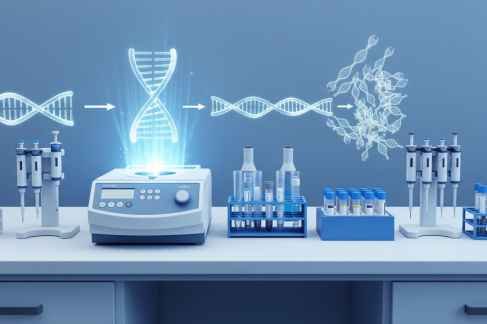
Polymerase chain reaction (PCR) is one of the most widely used techniques for amplifying specific DNA sequences in laboratory research. By producing large amounts of a selected genetic region from a small starting sample, PCR supports a wide range of molecular biology studies. The applications of PCR kits in molecular biology include gene amplification, cloning, genetic analysis, pathogen detection, mutation research, and gene expression studies.
What Are PCR Kits?
PCR kits contain the essential components needed to amplify a specific DNA sequence through a controlled series of reactions. Depending on the kit and its intended application, these components may include DNA polymerase, deoxynucleotide triphosphates (dNTPs), reaction buffers, primers, and other necessary reagents.
The PCR process involves repeated cycles of three basic steps: denaturation, primer annealing, and extension. During denaturation, the double-stranded DNA separates into two individual strands. Primers then attach to the target sequences during annealing. Finally, DNA polymerase extends the primers and creates new DNA strands.
Repeating these cycles allows the target sequence to be amplified, producing enough genetic material for detection or downstream analysis. Because PCR can work with relatively small amounts of starting material, it is particularly useful in molecular biology research where sample availability may be limited.
Different PCR formats are available for different research needs. Conventional PCR can be used to amplify and analyze DNA fragments, while reverse transcription PCR (RT-PCR) is used when the starting material is RNA. Real-time PCR allows researchers to monitor amplification as it occurs, while multiplex PCR can amplify multiple targets within a single reaction.
Major Applications of PCR in Molecular Biology
Gene Amplification
One of the fundamental uses of PCR is amplifying specific genes or DNA regions. Researchers can select a target sequence using appropriately designed primers and produce millions of copies through repeated amplification cycles.
Amplified DNA can then be used in sequencing, cloning, mutation analysis, genotyping, or other downstream procedures. This makes PCR a practical technique for working with specific genetic regions within complex biological samples.
Gene Cloning and Sequencing
PCR can help researchers obtain DNA fragments required for cloning experiments. Once a target region has been amplified, it may be prepared for insertion into an appropriate vector for further investigation or expression studies.
PCR is also frequently used before DNA sequencing. Amplifying a particular region can provide researchers with sufficient material for sequence analysis and help them investigate the structure or variations of a gene.
These applications are valuable in studies involving gene function, genetic engineering, recombinant DNA research, and molecular characterization.
Genetic Variation and Genotyping
PCR-based methods can help researchers investigate differences in DNA sequences between biological samples. By targeting specific genetic regions, scientists can study mutations, genetic markers, allelic variations, and other sequence differences.
Genotyping applications can support research into inherited characteristics, population genetics, disease-associated variants, and genetic diversity. PCR may also be combined with other analytical techniques to determine whether a particular sequence variant is present in a sample.
Pathogen Detection and Research
PCR-based molecular methods are widely used to detect genetic material associated with microorganisms. Researchers can design primers to target sequences that are characteristic of a particular pathogen or group of organisms.
This approach can support infectious disease research, microbial identification, strain characterization, and epidemiological studies. Real-time PCR can provide quantitative information about the target, while multiplex PCR can allow several targets to be investigated within one reaction.
PCR-based detection can also be useful when researchers need to identify organisms that are difficult to grow or characterize using conventional laboratory methods.
Gene Expression Research
PCR also has an important role in studies of gene expression. When RNA is the starting material, reverse transcription can be used to convert RNA into complementary DNA (cDNA). The resulting cDNA can then be amplified and analyzed.
Quantitative real-time PCR can help researchers compare the expression levels of selected genes under different experimental conditions. For example, scientists may examine changes in gene expression between treated and untreated samples or compare expression patterns across different tissues or cell types.
PCR in Mutation and Molecular Diagnostics Research
Researchers can use PCR to investigate known or suspected genetic mutations. By designing primers around a specific region of interest, scientists can amplify the relevant sequence and subsequently analyze it using sequencing or other molecular methods.
PCR-based approaches can therefore contribute to research involving genetic disorders, cancer-associated mutations, microbial resistance markers, and other molecular changes. The specific method used depends on the type of mutation and the required downstream analysis.
Factors to Consider When Selecting a PCR Kit
Choosing an appropriate PCR kit depends on the research objective and experimental design. Researchers should first consider the type of sample and target nucleic acid being analyzed.
Other factors may include:
- PCR format: Conventional, real-time, RT-PCR, or multiplex PCR may be appropriate for different applications.
- Specificity: The reagents and polymerase should support selective amplification of the intended target.
- Sensitivity: High sensitivity can be important when the target is present at a low concentration.
- Sample compatibility: The kit should be suitable for the biological material and sample preparation method being used.
- Reaction requirements: Researchers should review primer, template, reagent, cycling, and reaction-volume requirements.
- Downstream applications: The amplified product may need to be suitable for sequencing, cloning, electrophoresis, or other analysis.
Following the manufacturer’s recommended storage conditions and reaction protocols can also help maintain reagent performance and improve experimental consistency.
Why PCR Remains Important in Molecular Biology
PCR continues to be an important laboratory technique because of its versatility, sensitivity, and ability to selectively amplify genetic material. From basic gene research and sequencing to pathogen studies and genetic variation analysis, PCR can support many stages of molecular biology research.
The development of different PCR formats has further expanded its usefulness. Researchers can select approaches based on whether they need qualitative amplification, quantitative measurement, RNA analysis, or simultaneous detection of multiple targets.
Final Thoughts
PCR provides researchers with a practical way to amplify and investigate specific genetic sequences from biological samples. Its applications span gene analysis, cloning, sequencing, genotyping, pathogen research, mutation studies, and gene expression analysis.